Preserve History
The first deeded transfer of the property where Eidolon Preserve is today occurred in 1900. Philip Pendleton sold 307-acres of what was then known as the Armstrong Farm to Thomas Emmert, a Civil War veteran. The property was valued at $307 at the time. Emmert and his family lived in a small house just off the Old Coach Road. The house site has been marked by stone cairns.
In 1920, Emmert sold the property to Riley Yokum. It is unclear if Yokum ever lived on the property. Yokum then sold the property to Claude and Lyle Duckworth in 1929.
Around 1929, a forest fire scorched the mountain. One witness remembers the fire starting by sparks from B&O engine igniting brush and trees. Some fire scars are still visible on the oldest trees.
Claude built a house near the spring. He also built a small barn and raised goats. There are several stone walls erected by Claude that can still be seen today. One large boulder in a wall is inscribed “CHD 5-3-31.”

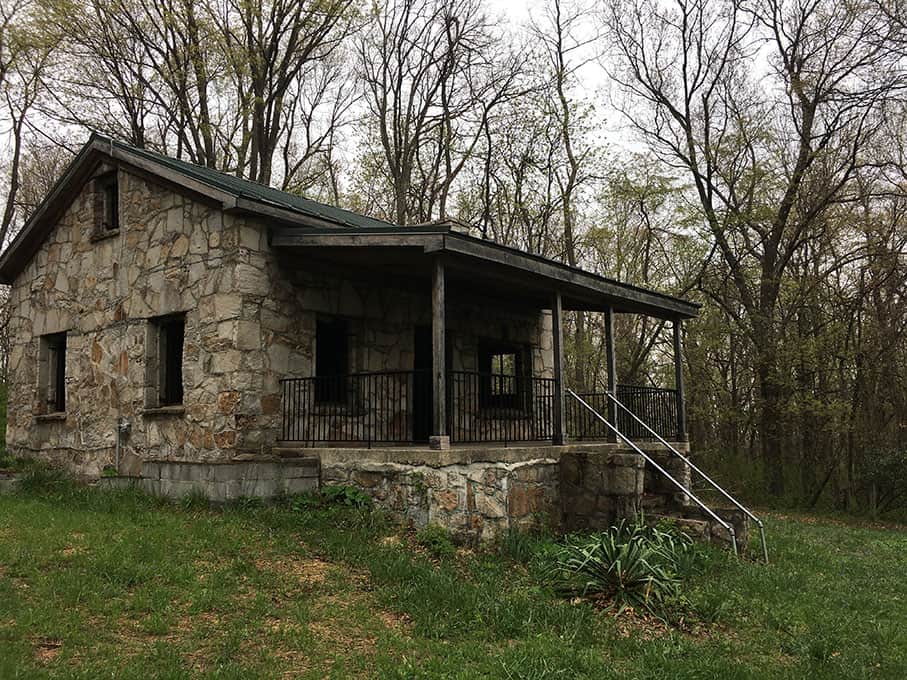
Marguerite Zapoleon on the front porch of the stone cottage creating notecards for the species she observed on the mountain.
In 1936, Claude sold the property to Henry and Fannie Twigg. By 1938, the Twiggs defaulted on their mortgage and the property was sold to the bank at auction.
Louis and Marguerite Zapoleon discovered the property that would become Eidolon during a vacation trip to Morgan County in 1939. For the next two years they continued to visit the property frequently on weekends and vacations. They took a hiatus from their visits during World War II, but returned to and purchased the property in 1945 for $700. The Zapoleons named it Eidolon after the phantom women of Greek mythology created by Zeus from mist and light. Translated from Greek, the word Eidolon means “image of the ideal.”
One of the first steps as landowners the Zapoleon’s took was to hire a forester to advise them on land management. At the forester’s suggestion, Mr. Zapoleon planted Russian Olive, Lespedeza and Multiflora Rose “to supply winter food for wild friends.” These species are all still present at Eidolon today and are now considered invasive species.
The Zapoleons built the stone cottage in 1951 and made it their full-time warm-season home in 1959.
The 1960s were very busy for the Zapoleons. In 1961, they signed a timber contract and had the whole property selectively logged. In 1962, Western Union built a microwave tower on the highest point at Eidolon. That same year, the stone cottage was destroyed in a fire accidentally set by visiting friends of the Zapoleons. They continued to visit the property for several years until Mr. Zapoleon passed in 1969.
In 1971, Mrs. Zapoleon made arrangements to convey the property to The Nature Conservancy upon her death. She wanted to make sure Eidolon remained intact as a natural asset for future generations.
For many years after that, Mrs. Zapoleon continued to return to Eidolon twice a year. She helped with the flora and fauna inventories and oversaw the establishment of the first trails on the property. She even celebrated her 92nd birthday with a party at the remains of the stone cottage. In 1985, she published a book about Eidolon titled “Everyone Needs a Mountain, or, Skylife at Eidolon.”
The Nature Conservancy took ownership of Eidolon, upon the death of Mrs. Zapoleon. In 2006, an agreement was made between The Nature Conservancy and PVAS to co-manage the property.
PVAS volunteer and WV Master Naturalist, Marcyanna Millet, transcribed all of Mrs. Zapoleon’s hand-written card files on the flora and fauna of Eidolon into a digital database. Volunteer, Elliot Kirschbaum, later refined the database. The links to access the files are below.
Click here to read more about Eidolon’s rich history!